The requirement for a new candidate to earn the Oracle Database Administration 2019 Certified Professional is to pass the exams Oracle Database Administration I 1Z0-082 and Oracle Database Administration II 1Z0-083. PassQuestion new released Oracle 1Z0-083 Dumps which have a high quality and have 95% similarity with the true examination questions.If you use PassQuestion Oracle 1Z0-083 Dumps, you can 100% pass your first time to attend Oracle Database certification 1Z0-083 exam.
1Z0-083 Exam Information - Oracle Database Administration II
An Oracle Database Administration 2019 Certified Professional has proven theoretical understanding of and the practical skills required to configure and manage Oracle Databases up to and including Oracle 19c. Passing this 2nd exam in a 2 exam path proves your skills in: installation, upgrades, patching, SQL programming skills, database and network administration and backup and recovery. This person also demonstrates fluency with some advanced skills such as multi-tenant, SQL performance monitoring and problem determination.
Audience:
Production Database Administrators (DBAs)
Development DBAs
DB Architects
DB designers and analysts.
Production Database Administrators (DBAs)
Development DBAs
DB Architects
DB designers and analysts.
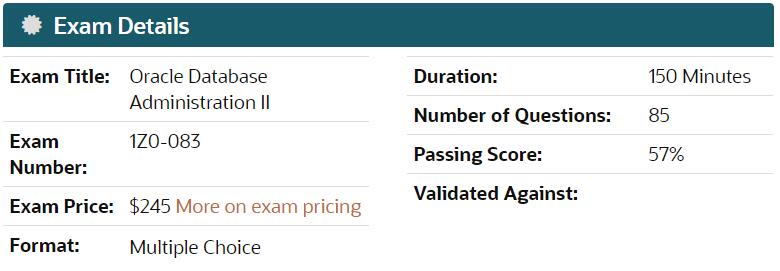
Oracle Database Administration II 1Z0-083 Exam Topics
Creating CDBs and Regular PDBs - Oracle Database: Managing Multitenant Architecture Ed 1
Backup and Duplicate - Oracle Database: Managing Multitenant Architecture Ed 1
Manage Application PDBs - Oracle Database: Managing Multitenant Architecture Ed 1
Recovery and Flashback - Oracle Database: Managing Multitenant Architecture Ed 1
Backup Strategies and Terminology - Oracle Database: Backup and Recovery Workshop
Restore and Recovery Concepts - Oracle Database: Backup and Recovery Workshop
Using Flashback Technologies - Oracle Database: Backup and Recovery Workshop
Duplicating a Database - Oracle Database: Backup and Recovery Workshop
Diagnosing Failures - Oracle Database: Backup and Recovery Workshop
Transporting Data - Oracle Database: Backup and Recovery Workshop
Install Grid Infrastructure and Oracle Database - Oracle Database: Deploy, Patch and Upgrade Workshop
Patching Grid Infrastructure and Oracle Database - Oracle Database: Deploy, Patch and Upgrade Workshop
Upgrading to Oracle Grid Infrastructure - Oracle Database: Deploy, Patch and Upgrade Workshop
Oracle Database 18c: New Features - Oracle Database: Deploy, Patch and Upgrade Workshop
Oracle Restart - Oracle Database: Deploy, Patch and Upgrade Workshop
Install Grid Infrastructure for a Standalone server - Oracle Database: Deploy, Patch and Upgrade Workshop
Using Availability Enhancements - Oracle Database 19c: New Features for Administrators
Monitoring and Tuning Database Performance - Oracle Database: Administration Workshop
Manage CDBs and PDBs - Oracle Database: Managing Multitenant Architecture Ed 1
Upgrading and Transporting CDBs and Regular PDBs - Oracle Database: Managing Multitenant Architecture Ed 1
Manage Security in Multitenant databases - Oracle Database: Managing Multitenant Architecture Ed 1
Configuring and Using RMAN - Oracle Database: Backup and Recovery Workshop
Performing Recovery - Oracle Database: Backup and Recovery Workshop
RMAN Troubleshooting and Tuning - Oracle Database: Backup and Recovery Workshop
Creating an Oracle Database by using DBCA - Oracle Database: Deploy, Patch and Upgrade Workshop
Upgrade the Oracle Database - Oracle Database: Deploy, Patch and Upgrade Workshop
Using General Overall Database Enhancements - Oracle Database 19c: New Features for Administrators
Using Diagnosibility Enhancements - Oracle Database 19c: New Features for Administrators
Tuning SQL Statements - Oracle Database: Administration Workshop
Backup and Duplicate - Oracle Database: Managing Multitenant Architecture Ed 1
Manage Application PDBs - Oracle Database: Managing Multitenant Architecture Ed 1
Recovery and Flashback - Oracle Database: Managing Multitenant Architecture Ed 1
Backup Strategies and Terminology - Oracle Database: Backup and Recovery Workshop
Restore and Recovery Concepts - Oracle Database: Backup and Recovery Workshop
Using Flashback Technologies - Oracle Database: Backup and Recovery Workshop
Duplicating a Database - Oracle Database: Backup and Recovery Workshop
Diagnosing Failures - Oracle Database: Backup and Recovery Workshop
Transporting Data - Oracle Database: Backup and Recovery Workshop
Install Grid Infrastructure and Oracle Database - Oracle Database: Deploy, Patch and Upgrade Workshop
Patching Grid Infrastructure and Oracle Database - Oracle Database: Deploy, Patch and Upgrade Workshop
Upgrading to Oracle Grid Infrastructure - Oracle Database: Deploy, Patch and Upgrade Workshop
Oracle Database 18c: New Features - Oracle Database: Deploy, Patch and Upgrade Workshop
Oracle Restart - Oracle Database: Deploy, Patch and Upgrade Workshop
Install Grid Infrastructure for a Standalone server - Oracle Database: Deploy, Patch and Upgrade Workshop
Using Availability Enhancements - Oracle Database 19c: New Features for Administrators
Monitoring and Tuning Database Performance - Oracle Database: Administration Workshop
Manage CDBs and PDBs - Oracle Database: Managing Multitenant Architecture Ed 1
Upgrading and Transporting CDBs and Regular PDBs - Oracle Database: Managing Multitenant Architecture Ed 1
Manage Security in Multitenant databases - Oracle Database: Managing Multitenant Architecture Ed 1
Configuring and Using RMAN - Oracle Database: Backup and Recovery Workshop
Performing Recovery - Oracle Database: Backup and Recovery Workshop
RMAN Troubleshooting and Tuning - Oracle Database: Backup and Recovery Workshop
Creating an Oracle Database by using DBCA - Oracle Database: Deploy, Patch and Upgrade Workshop
Upgrade the Oracle Database - Oracle Database: Deploy, Patch and Upgrade Workshop
Using General Overall Database Enhancements - Oracle Database 19c: New Features for Administrators
Using Diagnosibility Enhancements - Oracle Database 19c: New Features for Administrators
Tuning SQL Statements - Oracle Database: Administration Workshop
View Online 1Z0-083 Free Questions From Oracle Database Administration II 1Z0-083 Dumps
1.Which three are true about thresholds, metrics, and server-generated alerts? (Choose three.)
A. All metrics are instance related.
B. Cleared stateful alerts are displayed by querying DBA_ALERT_HISTORY.
C. A space usage management alert is automatically cleared after the underlying problem is resolved.
D. They are generated by SMON when a tablespace is 97% full.
E. Metrics are statistical counts for a specific unit.
F. STATISTICS_LEVEL must be set to ALL to generate alerts.
Answer: CEF
A. All metrics are instance related.
B. Cleared stateful alerts are displayed by querying DBA_ALERT_HISTORY.
C. A space usage management alert is automatically cleared after the underlying problem is resolved.
D. They are generated by SMON when a tablespace is 97% full.
E. Metrics are statistical counts for a specific unit.
F. STATISTICS_LEVEL must be set to ALL to generate alerts.
Answer: CEF
2.While backing up to an SBT channel, you determine that the read phase of your compressed Recovery Manager (RMAN) incremental level 0 backup is a bottleneck.
FORCE LOGGING is enabled for the database.
Which two could improve read performance? (Choose two.)
A. Increase the size of tape I/O buffers.
B. Disable FORCE LOGGING for the database.
C. Increase the size of the database buffer cache.
D. Enable asynchronous disk I/O.
E. Increase the level of RMAN multiplexing.
Answer: CE
FORCE LOGGING is enabled for the database.
Which two could improve read performance? (Choose two.)
A. Increase the size of tape I/O buffers.
B. Disable FORCE LOGGING for the database.
C. Increase the size of the database buffer cache.
D. Enable asynchronous disk I/O.
E. Increase the level of RMAN multiplexing.
Answer: CE
3.For which two requirements can you use the USER_TABLESPACE clause with the CREATE PLUGGABLE DATABASE command? (Choose two.)
A. to specify a default tablespace in a PDB cloned from another PDB in the same CDB.
B. to exclude all tablespaces except SYSTEM, SYSAUX, and TEMP when plugging in a PDB
C. to include specific user tablespaces only when relocating a PDB
D. to specify the list of user tablespaces to include when moving a non-CDB to a PDB
E. to exclude a temp tablespace when plugging in a PDB
F. to specify the list of tablespaces to include when creating a PDB from the CDB seed
Answer: EF
A. to specify a default tablespace in a PDB cloned from another PDB in the same CDB.
B. to exclude all tablespaces except SYSTEM, SYSAUX, and TEMP when plugging in a PDB
C. to include specific user tablespaces only when relocating a PDB
D. to specify the list of user tablespaces to include when moving a non-CDB to a PDB
E. to exclude a temp tablespace when plugging in a PDB
F. to specify the list of tablespaces to include when creating a PDB from the CDB seed
Answer: EF
4.Which three are true about requirements for various FLASHBACK operations? (Choose three.)
A. FLASHBACK transaction query requires undo to retrieve all versions of a row that existed between two points in time.
B. FLASHBACK drop requires that the RECYCLEBIN parameter be set to ON.
C. FLASHBACK version query requires that the RECYCLEBIN parameter be set to ON.
D. FLASHBACK DATA ARCHIVE requires undo to store all versions of all rows of a table being tracked.
E. FLASHBACK drop requires undo to retrieve all versions of a row that existed between two points in time.
F. FLASHBACK version query requires undo to retrieve all versions of a row that existed between two points in time.
Answer: ABC
A. FLASHBACK transaction query requires undo to retrieve all versions of a row that existed between two points in time.
B. FLASHBACK drop requires that the RECYCLEBIN parameter be set to ON.
C. FLASHBACK version query requires that the RECYCLEBIN parameter be set to ON.
D. FLASHBACK DATA ARCHIVE requires undo to store all versions of all rows of a table being tracked.
E. FLASHBACK drop requires undo to retrieve all versions of a row that existed between two points in time.
F. FLASHBACK version query requires undo to retrieve all versions of a row that existed between two points in time.
Answer: ABC
5.Which three actions are performed by the Oracle Preinstallation RPM, oracle-database-server xxxx-preinstall, for Oracle Grid Infrastructure, where xxxx is the Oracle version and release? (Choose three.)
A. performing checks to ensure minimum configuration requirements for Oracle Grid Infrastructure are met
B. creating the oracle OS user
C. creating the OSDBA (dba) group
D. creating thte oraInventory (oinstall) group
E. creating the grid OS user
F. configuring the OS for Oracle Automatic Storage Management shared storage access
Answer: CDF
A. performing checks to ensure minimum configuration requirements for Oracle Grid Infrastructure are met
B. creating the oracle OS user
C. creating the OSDBA (dba) group
D. creating thte oraInventory (oinstall) group
E. creating the grid OS user
F. configuring the OS for Oracle Automatic Storage Management shared storage access
Answer: CDF
6.Which two are true about common objects? (Choose two.)
A. They can be created only in CDB$ROOT.
B. They can be only metadata-linked in an application container.
C. They can exist in user-defined schemas only in application containers.
D. They can exist in CDB$ROOT and an application root.
E. They can be extended data-linked in CDB$ROOT.
F. They can be created only in an application root.
Answer: EF
A. They can be created only in CDB$ROOT.
B. They can be only metadata-linked in an application container.
C. They can exist in user-defined schemas only in application containers.
D. They can exist in CDB$ROOT and an application root.
E. They can be extended data-linked in CDB$ROOT.
F. They can be created only in an application root.
Answer: EF
Congratulation for the great post. Those who come to read your Information will find lots of helpful and informative tips. Microsoft Azure Solutions Architect Technologies courses AZ-300
ReplyDeleteI found one successful example of this truth through this blog. I am going to use such information now.
ReplyDeleteMD-100T03: Protecting Windows 10