To achieve the certification of Java SE 11 Developer, one needs to pass two certification exams; the first one is Java SE 11 Developer I 1Z0-815 exam while the second one is Java SE 11 Developer II 1Z0-816 exam. PassQuestion new released OCP Java 11 Part 2 Exam 1Z0-816 Dumps which have have a very close similarity with real exam. PassQuestion can promise that you can 100% pass your first time to attend OCP Java 11 certification 1Z0-816 exam.
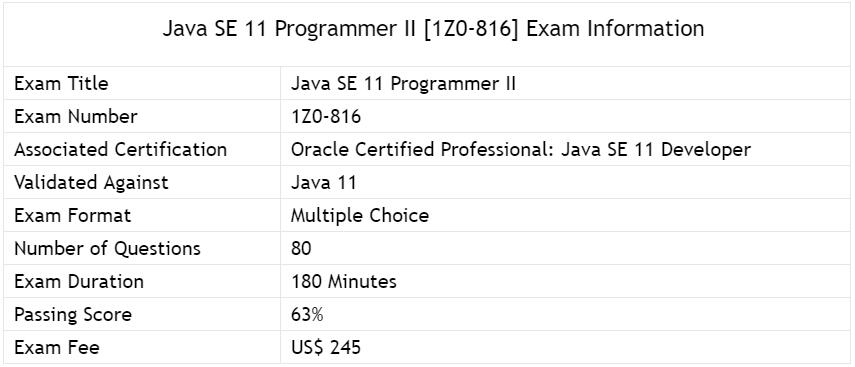
Java SE 11 Programmer II 1Z0-816 Exam Information
Java SE 11 Programmer II 1Z0-816 exam has multiple choice question framework and comprises of 80 MCQs for the candidate to answer. The completion duration for this exam is 3 hours i.e. 180 minutes with the passing bar set at 63% score.
This essentially means that a candidate needs to answer at least 52 questions correctly in order to pass the examination. The Java SE 11 Programmer II is firmly validated with the concepts of Java 11 SE build of the programming language.
Java SE 11 Programmer II 1Z0-816 Exam Objectives
Java Fundamentals
Java Interfaces
Functional Interface and Lambda Expressions
Built-in Functional Interfaces
Migration to a Modular Application
Concurrency
I/O (Fundamentals and NIO2)
Database Applications with JDBC
Annotations
Exception Handling and Assertions
Generics and Collections
Java Stream API
Lambda Operations on Streams
Services in a Modular Application
Parallel Streams
Secure Coding in Java SE Application
Localization
Java Interfaces
Functional Interface and Lambda Expressions
Built-in Functional Interfaces
Migration to a Modular Application
Concurrency
I/O (Fundamentals and NIO2)
Database Applications with JDBC
Annotations
Exception Handling and Assertions
Generics and Collections
Java Stream API
Lambda Operations on Streams
Services in a Modular Application
Parallel Streams
Secure Coding in Java SE Application
Localization
View Online 1Z0-816 Free Questions From PassQuestion OCP Java 11 Part 2 Exam 1Z0-816 Dumps
1.Given the code fragment:
Path currentFile = Paths.get(“/scratch/exam/temp.txt”);
Path outputFile = Paths get(“/scratch/exam/new.txt”);
Path directory = Paths.get(“/scratch/”);
Files.copy(currentFile, outputFile);
Files.copy(outputFile, directory);
Files.delete (outputFile);
The /scratch/exam/temp.txt file exists. The /scratch/exam/new.txt and /scratch/new.txt files do not exist.
What is the result?
A. /scratch/exam/new.txtand /scratch/new.txt are deleted.
B. The program throws a FileaAlreadyExistsException.
C. The program throws a NoSuchFileException.
D. A copy of /scratch/exam/new.txtexists in the /scratch directory and /scratch/exam/new.txt is deleted.
Answer: C
Path currentFile = Paths.get(“/scratch/exam/temp.txt”);
Path outputFile = Paths get(“/scratch/exam/new.txt”);
Path directory = Paths.get(“/scratch/”);
Files.copy(currentFile, outputFile);
Files.copy(outputFile, directory);
Files.delete (outputFile);
The /scratch/exam/temp.txt file exists. The /scratch/exam/new.txt and /scratch/new.txt files do not exist.
What is the result?
A. /scratch/exam/new.txtand /scratch/new.txt are deleted.
B. The program throws a FileaAlreadyExistsException.
C. The program throws a NoSuchFileException.
D. A copy of /scratch/exam/new.txtexists in the /scratch directory and /scratch/exam/new.txt is deleted.
Answer: C
2.Given the declaration:
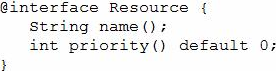
Examine this code fragment:
/* Loc1 */ class ProcessOrders { ... }
Which two annotations may be applied at Loc1 in the code fragment? (Choose two.)
A. @Resource(priority=100)
B. @Resource(priority=0)
C. @Resource(name=“Customer1”, priority=100)
D. @Resource(name=“Customer1”)
E. @Resource
Answer: AB
/* Loc1 */ class ProcessOrders { ... }
Which two annotations may be applied at Loc1 in the code fragment? (Choose two.)
A. @Resource(priority=100)
B. @Resource(priority=0)
C. @Resource(name=“Customer1”, priority=100)
D. @Resource(name=“Customer1”)
E. @Resource
Answer: AB
3.Given:
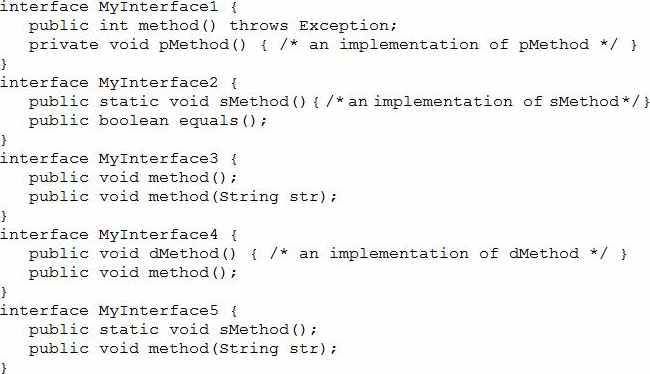
Which two interfaces can be used in lambda expressions? (Choose two.)
A. MyInterface1
B. MyInterface3
C. MyInterface5
D. MyInterface2
E. MyInterface4
Answer: CD
A. MyInterface1
B. MyInterface3
C. MyInterface5
D. MyInterface2
E. MyInterface4
Answer: CD
4.Given this enum declaration:
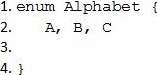
Examine this code:
System.out.println(Alphabet.getFirstLetter());
What code should be written at line 3 to make this code print A?
A. final String getFirstLetter() { return A.toString(); }
B. static String getFirstLetter() { return Alphabet.values()[1].toString(); }
C. static String getFirstLetter() { return A.toString(); }
D. String getFirstLetter() { return A.toString(); }
Answer: C
System.out.println(Alphabet.getFirstLetter());
What code should be written at line 3 to make this code print A?
A. final String getFirstLetter() { return A.toString(); }
B. static String getFirstLetter() { return Alphabet.values()[1].toString(); }
C. static String getFirstLetter() { return A.toString(); }
D. String getFirstLetter() { return A.toString(); }
Answer: C
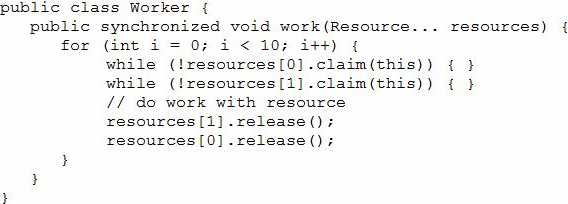
5.Given these two classes:
And given this fragment:
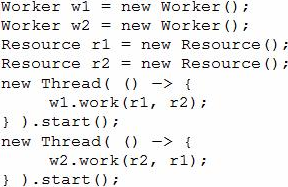
Which describes the fragment?
A. It throws IllegalMonitorStateException.
B. It is subject to deadlock.
C. It is subject to livelock.
D. The code does not compile.
Answer: D
A. It throws IllegalMonitorStateException.
B. It is subject to deadlock.
C. It is subject to livelock.
D. The code does not compile.
Answer: D
Very significant Information for us, I have think the representation of this Information is actually superb one. This is my first visit to your site. Microsoft Certified Azure Fundamentals
ReplyDelete